Garage Door Repair Scams | How to Avoid Them in Texas
Your garage door stops working. You search online, call the first company that shows up, and a technician arrives within the hour. That fast response feels reassuring.
Then the bill comes.
What started as a $49 service call turns into a $600 invoice for parts you didn't need, labor you didn't authorize, and a warranty that doesn't exist. You paid it because the technician had your door in pieces on the floor and you needed to get to work.
Garage door repair scams are more common than most homeowners realize — and Texas is one of the most heavily targeted states in the country. Fraudulent companies flood local search results with fake business listings, low bait prices, and high-pressure tactics designed to extract maximum money from homeowners in vulnerable moments.
This guide exposes exactly how these scams work, the red flags that identify them, and how to protect yourself every time you need garage door service.
Why the Garage Door Industry Attracts Scammers
Understanding why this industry gets targeted helps you stay alert.
Garage door failures are urgent. A door stuck open is a home security emergency. A door trapping your car inside makes you late for work. That urgency removes the time most consumers take to research, compare, and evaluate — which is exactly the environment scammers exploit.
The repairs also involve components most homeowners know nothing about. Springs, cables, torsion systems, and opener mechanics are unfamiliar territory for the average person. When a technician tells you that you need a "high-cycle lifetime spring" or a "dual-force cable assembly," most homeowners have no frame of reference to question it.
Add in the fact that a technician already has your door disassembled when they present the inflated quote — and the pressure to just pay and move on becomes enormous.
Scammers design their entire operation around these three factors: urgency, unfamiliarity, and leverage.
The Most Common Garage Door Repair Scams
The Bait-and-Switch Price
This is the most widespread scam in the industry. A company advertises an extremely low service call fee — $29, $39, or $49 — to get a technician through your door. Once they arrive and assess the door, the quote suddenly jumps to several hundred dollars for parts and labor.
The original low price covered nothing except showing up. Everything else gets added on — often with parts marked up 400% to 600% above their actual cost. Homeowners who push back get told the door is unsafe to operate and cannot be reassembled without the repair.
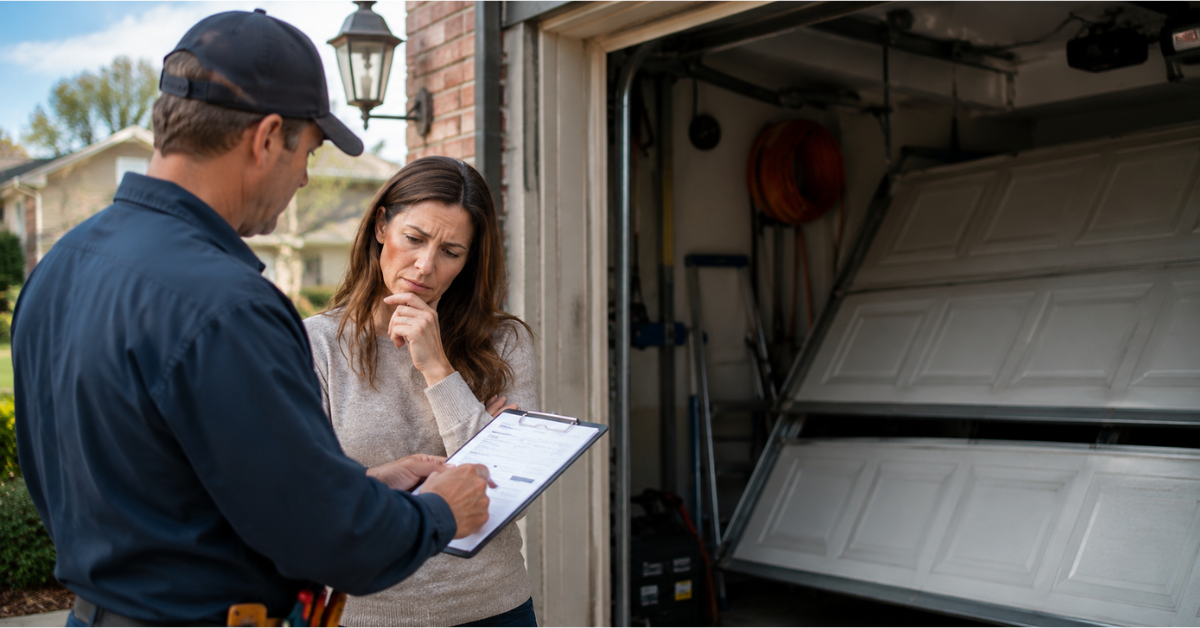
How to protect yourself: Ask for a full written quote before authorizing any work. A legitimate company gives you a complete price — parts and labor — before touching anything. If a company advertises unusually low service fees, treat that as a red flag, not a bargain.
Unnecessary Parts Replacement
A technician looks at your door, identifies a legitimate problem — say, a worn roller — and then tells you the
spring, cables, tracks, and opener all need replacement too. You have one bad roller. You leave with a $900 invoice.
This scam works because the technician uses technical language, points at components that look worn from normal use, and creates urgency around safety risks. Most homeowners cannot tell the difference between a component that needs replacement and one that has years of life left.
How to protect yourself: Ask the technician to show you the specific damage on each component they recommend replacing. Ask how long the remaining components realistically have before they need attention. A trustworthy technician explains clearly. A scammer deflects, repeats safety warnings, and pressures you to decide immediately.
Fake or Non-Existent Parts
Some fraudulent companies install cheap, counterfeit springs and cables while billing you for premium brand-name components. The counterfeit parts fail significantly faster than quality ones — often within months — which brings the technician back for another high-margin service call.
In more extreme cases, companies have charged for parts that were never installed at all — billing for a cable replacement while leaving the original frayed cable in place.
How to protect yourself: Ask to see the packaging for any parts being installed. Legitimate suppliers provide labeled packaging with brand names, specifications, and part numbers. Ask what brand of spring is being installed and look it up. If the technician cannot or will not show you the parts packaging, that is a serious red flag.
The Lifetime Warranty Trap
A company offers a "lifetime warranty" on parts and labor to justify a dramatically inflated price. It sounds like exceptional value — until you need to use it.
The warranty exists only as long as the company does. Many scam operations deliberately cycle through business names, changing their listed name every year or two while operating from the same phone number and personnel. When you call to claim your lifetime warranty, the business no longer exists under that name, and the new entity has no obligation to honor it.
How to protect yourself: Research the company's history before accepting any warranty as a selling point. Look up how long they've operated under their current name. Check their Better Business Bureau profile. A warranty from a company with a two-month-old listing means nothing.
Fake Google Business Listings
This is the scam that catches the most homeowners — because it targets the exact moment of searching for help. Fraudulent companies create multiple fake Google Business profiles using legitimate-sounding names, local addresses that are actually empty lots or mailbox services, and fabricated five-star reviews.
When you search "garage door repair near me" in an urgent moment, these fake listings appear at the top of local results. The phone number connects to a call center that dispatches subcontractors with no training, no insurance, and no accountability — often charging whatever they believe the homeowner will pay.
How to protect yourself: Before calling any company from a search result, check how long their Google listing has been active. Read reviews carefully — look for specific detail about the job, the technician's name, and the location. Generic five-star reviews with no specifics are often fabricated. Search the company name plus "scam" or "complaint" and check the BBB website for their rating and complaint history.
Pressure to Decide Immediately
Any technician who tells you the door is dangerous and you must authorize repairs right now — before getting a second opinion, before calling your spouse, before looking anything up — is using a pressure tactic designed to prevent you from thinking clearly.
Urgency is manufactured. A door that needs a spring replaced can wait an hour while you make a phone call. A door that needs a cable inspection is not going to collapse the moment you step away. Legitimate technicians give you a written quote and let you decide on your own timeline.
How to protect yourself: The moment a technician creates artificial urgency, slow down rather than speed up. Say you need fifteen minutes to make a call. A professional will wait. A scammer will escalate the pressure — which tells you everything you need to know.
Red Flags That Identify a Garage Door Scam Operation
Use this checklist before and during any service call.
Before they arrive:
- The service fee is dramatically lower than competitors.
- The company has no physical address or lists a non-existent location.
- Online reviews are generic, numerous, and were all posted within a short time window.
- The company has no BBB listing or has an F rating with unresolved complaints.
- The website was created recently with no company history visible.
When the technician arrives:
- They arrive in an unmarked vehicle with no company branding
- They do not show identification or a company badge
- They refuse to provide a written quote before beginning work
- They immediately recommend replacing multiple components without detailed explanation
- They cannot show you the packaging for parts they claim to be installing
- They pressure you to decide before you can get a second opinion
- They demand cash payment only
After the quote:
- The final invoice bears no resemblance to the original price discussed
- Parts are listed with vague descriptions rather than specific brand names and specifications
- The warranty offer cannot be verified in writing with clear terms
How to Find a Garage Door Company You Can Actually Trust
Knowing the scams is half the battle. The other half is knowing what a legitimate, trustworthy garage door company actually looks like.
Check the BBB first. The Better Business Bureau maintains verified ratings and complaint histories. A company with an A or A+ rating and years of accreditation has a demonstrated track record. Fix N Go Garage Door Repair carries a BBB A+ rating — earned through consistent service quality and resolved customer interactions, not purchased.
Look for a physical address and local history. A company that has operated in your city for years under the same name, with the same phone number, and with a verifiable physical address is dramatically less likely to be running a scam operation. Business continuity is accountability.
Read reviews for specifics. Genuine customer reviews mention the technician's name, describe the specific repair, reference the price paid, and reflect individual experiences. A wall of five-star reviews that all say "great service, fast response" with no details is a fabrication pattern.
Ask for a written quote before work begins. Every reputable garage door company provides a complete written estimate before touching your door. If a company refuses to put a price in writing before starting work, end the service call.
Verify insurance and licensing. Ask directly whether the company carries liability insurance and worker's compensation coverage. A legitimate company answers immediately and can provide documentation. An uninsured technician working on your property makes you liable for any injury that occurs during the job.
Why Texas Homeowners Trust Fix N Go Garage Door Repair
Fix N Go Garage Door Repair has served Texas homeowners for over 20 years under the same name, with the same commitment to honest, transparent service. We are the answer to every red flag listed in this article.
Transparent pricing — You receive a complete written quote before any work begins. The price you approve is the price you pay. There are no surprise line items at the end.
BBB Accredited with A+ Rating — Our Better Business Bureau profile reflects two decades of accountable service. Every complaint is addressed. Every customer matters.
Fully insured and bonded — Our technicians carry full liability and worker's compensation insurance on every job. Your home and your property are covered.
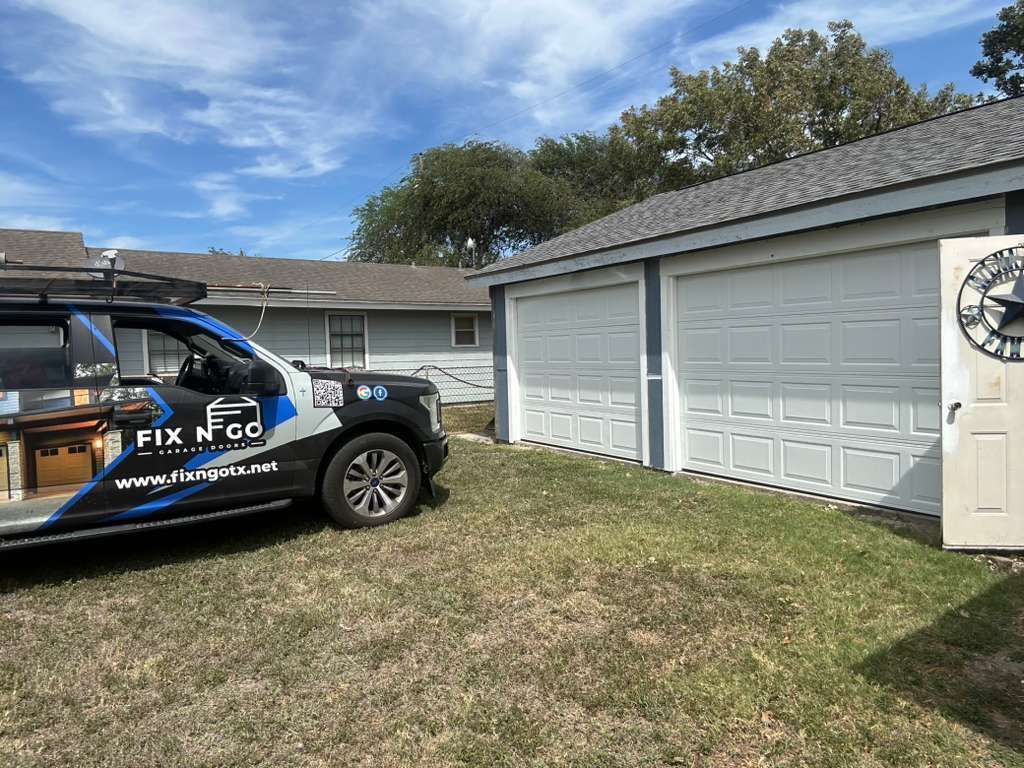
Branded vehicles and uniformed technicians — Every Fix N Go technician arrives in a marked company vehicle and carries company identification. You know exactly who is in your home.
Verified five-star reviews — Thousands of genuine reviews from real Texas homeowners across Google, Yelp, Nextdoor, and Facebook — with specific details, technician names, and real locations.
No pressure, ever — We give you a written quote and let you decide. If you want a second opinion, we respect that completely. Our work stands on its own merits.
Frequently Asked Questions
Q: How do I verify a garage door company is legitimate before they arrive?
A: Search the company name on the Better Business Bureau website and check their rating and complaint history. Look up how long their Google Business listing has been active and read reviews for specific details. Search the company name plus "scam" or "complaint" to surface any reported issues. Confirm they have a real physical address — not a mailbox service — and ask directly about their insurance coverage before booking.
Q: What should I do if I think I've already been scammed by a garage door company?
A: Document everything — photos of the work, copies of any invoices, records of payments made. File a complaint with the Better Business Bureau and your state's Attorney General consumer protection office. If you paid by credit card, contact your card issuer about a dispute. Leave a detailed review on Google and Yelp to warn other homeowners. If the amount is significant, consult with a consumer protection attorney.
Q: Can I get a second opinion on a garage door repair quote?
A: Absolutely — and any legitimate technician will respect your right to do so. Call Fix N Go for a second opinion at any time. We assess your door independently, give you a transparent written quote, and let you make a fully informed decision. A technician who pressures you not to get a second opinion is protecting a fraudulent quote, not your interests.
Q: What is the average cost of common garage door repairs in Texas?
A: Legitimate repair costs vary by component, door size, and whether parts require special ordering. Fix N Go provides free, transparent quotes on every job. As a general benchmark: if a quote for a single spring replacement exceeds what multiple reputable companies charge for the same repair, you are likely facing price gouging.
You might also like
Fix N Go Blog