Why Won’t My Commercial Garage Door Open or Close?
A commercial garage door that won’t open or close can bring business to a halt fast. Deliveries get delayed, employees get stuck, and security becomes a real concern. The good news is: many problems are predictable, and some are simple to spot. The key is knowing what’s safe to check yourself—and what should be left to a trained technician.
In this guide, we’ll walk through the most common reasons a commercial garage door won’t open or close, what you can troubleshoot right away, and how to prevent the issue from coming back.
A Quick Safety Note
Commercial doors are heavier, more complex, and more dangerous than most residential doors. Springs, cables, and high-tension hardware can cause severe injury if handled incorrectly. If you see broken cables, a hanging door, a snapped spring, or a door stuck halfway, stop and call a commercial door professional. That said, there are several safe, practical checks you can do before you place a service call.
The Most Common Reasons a Commercial Garage Door Won’t Open or Close
1) Power issues (more common than you’d think)
If your door doesn’t respond at all—no movement, no lights, no motor sound—power is the first suspect.
What to check:
- Is the opener plugged in and the outlet working?
- Has a breaker tripped (especially after storms or power surges)?
- Is the disconnect switch turned off (common in warehouses and shops)?
- Are there power-saving timers or building controls cutting power overnight?
Quick tip: If the opener’s lights are off and nothing responds, it’s almost always power or a control board issue.
2) Emergency release or manual chain is engaged
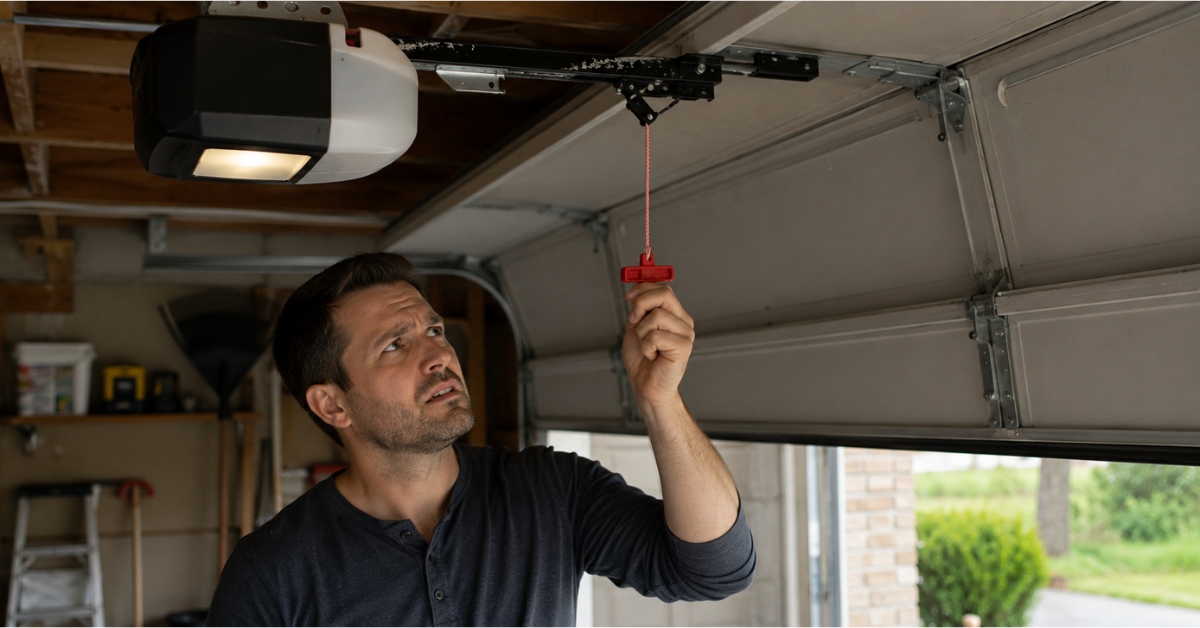
Commercial operators often have a hoist/chain system or a manual release. If it’s engaged, the motor may run but the door won’t move—or the operator won’t run at all as a safety feature.
What it looks like:
- Door moves by hand but not by motor (or vice versa)
- Operator appears “disconnected”
- You recently had
maintenance, a fire drill, or someone tested manual mode
Safe action: Check the operator’s manual release/hoist position and reset it if you know the proper method for your model. If you’re unsure, stop—forcing it can damage gears.
3) Safety sensors are blocked or misaligned (photo eyes)
Many commercial doors use photo eyes near the floor to prevent the door from closing on a person, pallet, or vehicle. If something blocks the beam—or the sensors are out of alignment—the door may refuse to close or may reverse immediately.
Common causes:
- Dust, forklift traffic, bumped sensor brackets
- Storage placed too close to the opening
- Condensation or dirty lenses
What to do:
- Look for a blinking sensor light (often signals misalignment)
- Wipe the lenses with a soft cloth
- Remove any obstruction in the doorway area
If your door closes but reverses right away, sensors are one of the first things to check.
4) Something is blocking the tracks or the door path
Commercial facilities collect debris: packaging straps, small bolts, pallets that inch too close, or even ice buildup near the threshold.
Signs:
- Door starts moving then stops abruptly
- You hear the operator strain or the door “bind”
- The door looks crooked or rubs one side
Safe check:
- Inspect both vertical tracks and the threshold area
- Look for dents in the track, loose brackets, or a roller that popped out
If the track is bent or a roller is off-track, do not force the door. That’s a “call a pro” situation.
5) Broken torsion spring or stretched counterbalance system
Commercial doors rely on a spring/counterbalance system to lift the door safely. If a spring breaks, the opener may not lift the door—or may lift a little and stop to prevent motor damage.
Red flags:
- Loud bang earlier (classic spring break sound)
- Door feels extremely heavy or slams down
- Door only lifts a few inches
- Cables look loose or uneven
Important: Do not attempt spring repair yourself. Spring tension is dangerous and requires special tools and training.
6) Cable problems (frayed, loose, or off the drum)
Cables help lift the door evenly. If one cable slips or frays, the door may jam, hang crooked, or stop halfway.
What you might notice:
- One side of the door sits higher than the other
- Grinding or scraping on one side
- Visible fraying near the bottom brackets
This is another case where commercial overhead door repair is the safest next step.
7) Limit settings are off (door “thinks” it’s closed or open)
Commercial operators use limits to know where “fully open” and “fully closed” are. If limits drift or were adjusted incorrectly, the door may stop short, refuse to close fully, or reverse unexpectedly.
Common triggers:
- Recent service or adjustments
- Temperature swings causing slight expansion/contraction
- Wear in mechanical limit assemblies
What you can do: If your operator has a simple reset procedure and you’re trained on it, you can try recalibration. If not, call a technician—incorrect limit adjustments can cause the door to slam or strain.
8) Force settings are too sensitive (or not sensitive enough)
Modern operators monitor resistance. If the force setting is too low, the door stops when it feels minor resistance (like stiff rollers or cold weather). If too high, it can become unsafe.
Symptoms of force issues:
- Door stops in the same spot repeatedly
- Door reverses with no obvious obstruction
- Operator hums or strains without moving the door smoothly
Force adjustments should be handled carefully. If you manage a facility, it’s worth having a pro verify settings as part of routine service.
9) Remote, keypad, or control station problems
Sometimes the door is fine—the control device isn’t.
Quick checks:
- Replace remote batteries
- Confirm the wall button works (if wall works, remote/keypad may be the issue)
- Check for damaged wiring at the wall station (frequent in busy facilities)
- Make sure the operator isn’t in “lock” or vacation mode (some systems have it)
If none of the control methods work, suspect power, wiring, board failure, or a safety lockout.
10) Opener/operator problems (motor, capacitor, circuit board)
If the operator clicks, hums, or tries to start but fails, the issue may be internal.
Common operator issues:
- Worn gear assemblies
- Failed capacitor (motor hums but doesn’t start properly)
- Overheated motor (temporary shutdown)
- Logic board failure from power surges
Practical step: Let the operator cool down if it seems overheated (heavy-use cycles can trigger thermal protection). If it repeats, schedule service.
11) Weather-related issues (cold, ice, wind load)
Commercial doors face tougher conditions—especially at loading docks.
Examples:
- Ice at the bottom seal makes the door “stick”
- High wind creates pressure that pushes the curtain/sections into the track
- Cold thickens grease, making rollers sluggish
Safe action: Clear ice gently, check for frozen seals, and keep track hardware maintained with appropriate lubricants (not heavy grease that attracts dirt).
Step-by-Step Commercial Garage Door Troubleshooting (Safe Checks)
If your commercial garage door won’t open or close, run through this sequence:
- Look and listen. Does the operator light turn on? Do you hear the motor? Any unusual grinding?
- Check power. Outlet, breaker, disconnect switch.
- Try the wall control. If wall works but remote doesn’t, it’s a remote/keypad issue.
- Inspect photo eyes. Clean lenses, remove obstructions, confirm alignment.
- Check the tracks and doorway. Remove debris, look for dents, check if the door is crooked.
- Stop if you see spring/cable trouble. If anything looks broken, frayed, or uneven—call service.
This approach avoids guesswork and reduces the chance of making the problem worse.
When You Should Call a Pro Immediately
Call a commercial overhead door technician if you notice:
- A broken spring (bang sound, heavy door, won’t lift)
- Frayed or loose cables
- Door is crooked, stuck, or off-track
- Track is bent or hardware is pulling out of the wall
- Operator smokes, smells burnt, or repeatedly trips breakers
- The door is a security risk (stuck open at a facility)
These repairs often require specialized tools, lift equipment, and safety procedures.
How to Prevent This From Happening Again
Commercial doors live a hard life—daily cycles, forklifts, dust, and weather. Preventive maintenance saves money and downtime.
A simple prevention plan:
- Keep tracks clear and clean (especially near loading docks)
- Inspect photo eyes weekly in high-traffic areas
- Listen for new noises (they’re early warning signs)
- Schedule professional tune-ups based on usage cycles
- Replace worn rollers and hinges before they fail
- Protect the operator with surge protection if power is unstable
Even small habits—like keeping pallets away from the opening—can prevent recurring shutdowns.
Conclusion
When a commercial garage door won’t open or close, it’s usually caused by power issues, safety sensors, obstructions, misaligned tracks, or worn counterbalance parts like springs and cables. Start with the safe checks: power, controls, sensors, and obvious blockages. If you see anything involving springs, cables, or a door that’s hanging unevenly, stop and call a professional—those parts carry serious risk.
A little routine maintenance goes a long way. The goal isn’t just getting the door moving today—it’s keeping your operation running smoothly tomorrow.
FAQs
Q1: Why does my commercial garage door start closing then reverse?
A: Usually it’s a safety issue: blocked/misaligned photo eyes, an obstruction, or force settings that detect resistance. Clean and align sensors and check the doorway path.
Q2: My operator hums but the door doesn’t move—what does that mean?
A:
This can indicate a stuck door, a failed capacitor, or a mechanical issue like a broken spring causing too much load. If the door feels heavy, stop and call a technician.
Q3: Can I open a commercial garage door manually if the power is out?
A:
Many systems allow manual operation via hoist/chain or emergency release, but procedures vary. Follow your operator’s manual and never force the door if it feels too heavy.
Q4: How do I know if the spring is broken on a commercial overhead door?
A:
Common signs include a loud bang, a door that won’t lift (or only lifts a few inches), or a door that suddenly feels extremely heavy. Springs should be serviced by pros only.
Q5: How often should a commercial garage door be serviced?
A: It depends on usage cycles. High-traffic doors may need more frequent inspections (often quarterly), while lighter-use doors might be fine with semiannual service. If the door is mission-critical, a preventive schedule is worth it.
You might also like
Fix N Go Blog