Garage Door Replacement Cost vs Repair Cost
Your garage door is giving you trouble — and now you face the question every Texas homeowner eventually confronts.
Do you repair it or replace it?
Repair feels cheaper in the moment. Replacement feels like a bigger investment but might make more sense long-term. The wrong choice costs you money twice — once when you pay for it, and again when the problem comes back.
This guide gives you an honest, practical breakdown of what repairs and replacements actually cost in Texas, the factors that determine which route makes financial sense, and the specific situations where each decision is clearly the right one.
What Garage Door Repairs Actually Cost in Texas
Repair costs vary significantly based on what component failed, the size of your door, and the extent of the damage. Here's an honest look at what Texas homeowners typically pay for the most common repairs.
Spring Replacement
Springs are the most frequently replaced component in any garage door system. A single torsion spring replacement on a standard single-car door runs between $150 and $250 for parts and labor combined. A two-car door with a dual spring system typically costs $200 to $350 for both springs replaced together.
Replacing both springs at the same time is almost always the right call — even if only one has broken. Springs installed at the same time wear at the same rate. When one breaks, the other is close behind. Replacing both together costs far less than two separate service calls within months of each other.
Cable Replacement
A single lift cable replacement runs between $100 and $200. Both cables replaced together — the recommended approach for the same reason as springs — typically costs $150 to $250. Cable replacement usually pairs with a spring inspection, since a broken spring is frequently what caused the cable failure in the first place.
Roller Replacement
Full roller replacement on a standard residential door — typically ten rollers — costs between $100 and $180 including labor. Nylon roller upgrades run slightly higher but last longer and operate more quietly, making them worth the marginal difference for most homeowners.
Track Repair and Realignment
Minor track realignment — loose brackets, slight misalignment — runs between $75 and $150. Bent track sections that require straightening or partial replacement cost $125 to $250 depending on severity. Full track replacement on both sides of a two-car door runs $200 to $400.
Opener Repair
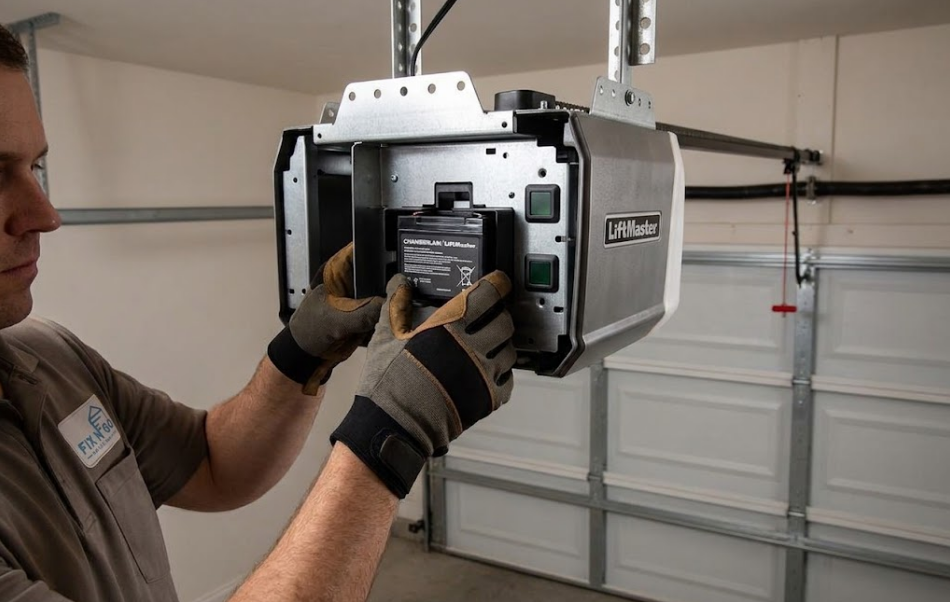
Opener repairs range widely based on what failed. Circuit board replacement costs $100 to $200. Drive gear replacement runs $75 to $150. Full opener motor unit replacement — when repair is no longer practical — costs $250 to $500 installed, depending on the drive type and horsepower rating.
Panel Replacement
A single damaged panel replacement costs $150 to $400 per panel depending on the door style, material, and whether the manufacturer still produces that panel design. This is where the repair vs replace calculation gets interesting — older doors with discontinued panel designs often cost more to repair with a single replacement panel than a full door replacement would.
Off-Track Repair
Getting a derailed door back on track costs $100 to $200 for the realignment itself. If the derailment damaged cables, rollers, or track sections, those repairs add to the total. Emergency off-track calls outside business hours typically run $50 to $100 higher.
What a Full Garage Door Replacement Costs in Texas
Replacement cost depends on three things: door size, material, and insulation level.
Single-Car Door (8x7 or 9x7)
A basic single-car steel door with standard insulation, professionally installed, runs between $700 and $1,200. Mid-range options with better insulation, decorative hardware, and improved panel design cost $1,000 to $1,800. Premium wood composite, full-view aluminum, or custom-designed doors push $2,000 and above.
Two-Car Door (16x7)
A standard two-car steel door installed runs $900 to $1,500 on the lower end. Mid-range two-car doors with insulation upgrades and design options cost $1,400 to $2,500. High-end options — carriage house style, wood composite, or premium full-view glass — run $2,500 to $5,000 and beyond.
What's Included in Replacement Cost
Professional installation includes removal and disposal of the old door, installation of the new door with all hardware, track installation, spring and cable setup calibrated to the new door's weight, and opener compatibility testing. Some companies include hardware upgrades as part of the installation package.
The Repair vs Replace Decision: How to Think About It
The cost comparison alone doesn't answer the question. These are the factors that determine which decision actually makes financial sense for your specific situation.
The 50% Rule
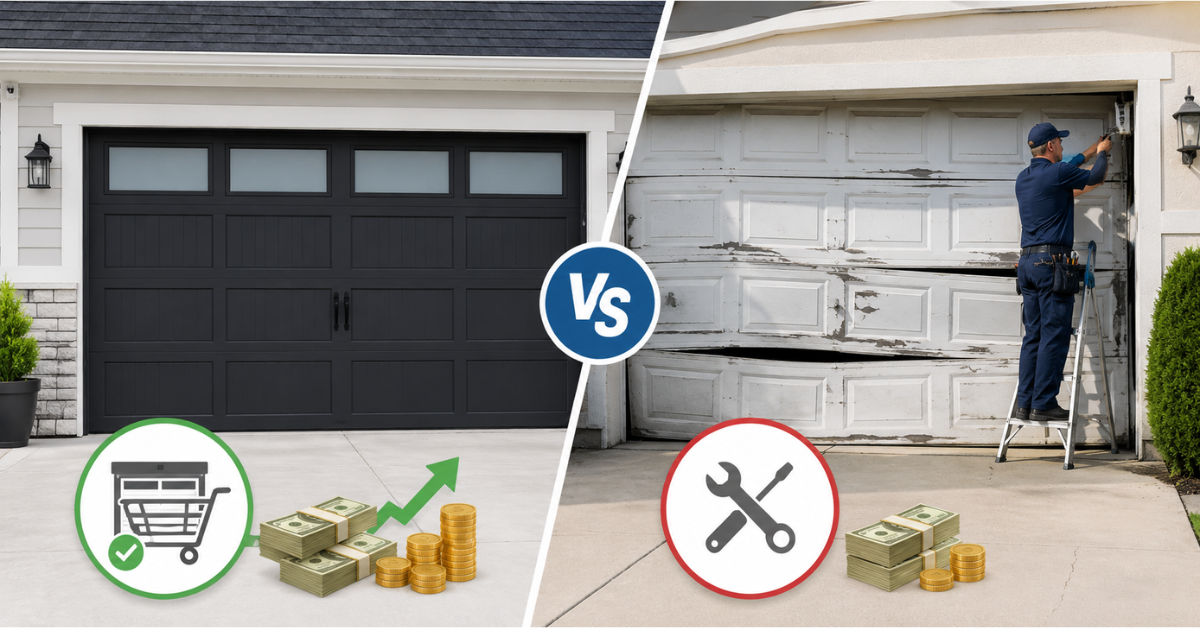
The most practical decision framework for any mechanical system is this: if the repair costs more than 50% of the replacement cost, replacement is almost always the smarter financial decision.
A repair that costs $600 on a door that would cost $1,000 to replace leaves you with a repaired old door that still has aging components, while $400 more gets you a new system under full warranty with years of reliable service ahead.
Apply this calculation every time a repair quote surprises you.
Age of the Door
A garage door has a functional lifespan of 15 to 30 years depending on material, maintenance history, and usage frequency. A door under ten years old with a single component failure almost always warrants repair — the core system has plenty of life remaining. A door over 20 years old with recurring problems is telling you something. Pouring repair money into an aging system delays the inevitable while stacking costs.
Frequency of Repairs
One repair in five years is normal maintenance. Two or three repairs in twelve months is a pattern. A door that requires repeated service calls within a short period has underlying systemic wear — the springs went, then the cables, now the opener struggles. Each repair fixes one symptom while the aging system produces the next. At that point, replacement resets everything and eliminates the repair cycle.
Energy Efficiency
Older garage doors — particularly uninsulated steel or wood doors — allow significant heat transfer into attached garages. In Texas summers, a poorly insulated garage door forces your home's HVAC system to work harder to maintain interior temperature. A modern insulated replacement door with a high R-value pays back part of its cost through reduced energy bills every single month.
If your garage door is old and uninsulated, the energy savings from replacement are a genuine factor in the financial calculation — not just a marketing talking point.
Curb Appeal and Home Value
A garage door covers roughly 30% of most home's front-facing exterior. An outdated, dented, or faded door drags down curb appeal in a way that affects real estate value directly. Real estate professionals consistently rank garage door replacement among the highest return-on-investment home improvements — studies show replacement returning 90% to 100% of its cost in added home value. If you're planning to sell within five years, a new door pays for itself at the listing.
Panel Availability
If your door was manufactured by a company that no longer produces your panel design — a common situation with doors over fifteen years old — a single panel replacement can cost as much or more than a new door entirely. When panel sourcing becomes expensive or impossible, replacement is objectively the more economical path.
Get an Honest Assessment from Fix N Go
At Fix N Go Garage Door Repair, we tell you the truth — even when the truth is that repair doesn't make financial sense for your situation.
Our technicians assess your door's age, condition, repair history, and the cost of the required fix against replacement options before recommending anything. We never push replacement to generate a larger ticket, and we never recommend repair on a door that genuinely needs replacing.
Garage Door Repair Services — Spring replacement, cable replacement, roller replacement, track repair, opener repair, and off-track correction. Same-day service with transparent pricing and parts on every truck.
Garage Door Replacement — We install top brands including Clopay, Amarr, Wayne Dalton, CHI, and Martin. Single and two-car doors in all materials and insulation levels. Full installation includes hardware, springs, cables, and opener compatibility testing.
Garage Door Panel Replacement — When one section is damaged and the rest of the door has life remaining, we source and install matching replacement panels where available.
Free Estimates — New door installation estimates are completely free. Call us, describe your situation, and we give you honest numbers for both repair and replacement so you can make a fully informed decision.
Frequently Asked Questions
Q: How do I know if my garage door is worth repairing or replacing?
A: Apply the 50% rule first — if the repair costs more than half of what a replacement would cost, replacement usually makes more financial sense. Then factor in age: doors under ten years old almost always warrant repair. Doors over 20 years old with recurring problems or structural damage are strong replacement candidates. Fix N Go gives you honest numbers for both options so you can decide with full information.
Q: What is the average lifespan of a residential garage door in Texas?
A: A quality steel door with regular maintenance lasts 20 to 30 years. Wood doors in humid Texas climates last 15 to 20 years without consistent sealing and painting. Springs last 7 to 12 years depending on cycle frequency and lubrication habits. Cables last 8 to 15 years. Openers last 10 to 15 years. Regular annual maintenance extends every component's lifespan significantly.
Q: Does homeowner's insurance cover garage door repair or replacement?
A: It depends on the cause. Damage from a covered peril — storm damage, vehicle impact, vandalism — is typically covered subject to your deductible. Normal wear and mechanical failure are not covered events under standard homeowner's policies. If your door was damaged by a storm or vehicle impact, file a claim before authorizing any repair work so the insurance adjuster can assess the damage first.
Q: Is it cheaper to repair a garage door opener or replace it entirely?
A: Minor opener repairs — drive gear replacement, circuit board swap, sensor replacement — cost $75 to $200 and make sense on openers under ten years old. An opener over fifteen years old that requires a major component repair is usually better replaced entirely. Modern openers offer significantly better security (rolling code technology), smartphone connectivity, battery backup, and quieter operation — features older units cannot be upgraded to provide.
Q: How long does a garage door installation take?
A: A standard residential garage door replacement by a professional crew takes three to five hours from start to finish. This includes removing and disposing of the old door, installing the new door and all hardware, setting spring tension, calibrating the opener, and testing full operation. Fix N Go completes most installations on the same day the estimate is approved.
You might also like
Fix N Go Blog